Bedding & Sleep Comfort
How to Match Bedding and Pillows to an Adjustable Bed
An adjustable bed can turn a familiar mattress into a more flexible sleep surface—but raising the head or feet changes how sheets, blankets, and pillows behave. The right fit comes down to a few practical details: mattress depth, secure sheet construction, split-bed configuration, and pillow support that works in more than one position.
Published November 2, 2026
An adjustable base makes it possible to lift the head, raise the legs, or choose a position between the two. That movement can feel like a small luxury at bedtime, whether you are reading, relaxing, or settling into a position that feels more comfortable. But a bed that moves also asks more of its bedding. A fitted sheet that sits neatly on a flat mattress may creep loose when the head section rises; a bulky pillow may push the neck forward; and a shared comforter can become awkward if each side of the bed moves independently.
The solution is not necessarily a full bedroom makeover. Thoughtful measurements and a few considered choices can keep bedding secure and make pillow support easier to adjust. Start with the mattress and base you have, then look at how you actually use the bed. Do you raise the head every night? Do you sleep on a split king with a partner? Do you prefer crisp, lightweight sheets or a softer, more enveloping layer? Those answers are more useful than a label promising universal compatibility.
This guide explains how to match fitted sheets, mattress layers, covers, and pillows to an adjustable bed, with an emphasis on fit and everyday function. It is an informational guide, not a substitute for the instructions supplied with your mattress or adjustable base. When in doubt, check the base manufacturer’s recommendations before adding layers or accessories.
Why adjustable beds change bedding fit
On a stationary bed, the mattress stays in one plane. An adjustable base bends the sleep surface at one or more joints, changing the angle beneath the bedding. As the head or foot section lifts, fabric can be pulled diagonally across the mattress. Sheets may tug at the corners, a duvet can slide toward the foot of the bed, and a loose top layer can bunch where the base articulates.
The degree of movement depends on the base, mattress, and chosen position. A modest head incline may cause little disruption, while frequent changes between a flat position and a pronounced elevation can test a loose-fitting sheet. Bedding that stays smooth on a flat bed is not automatically well suited to movement. Secure elastic, accurate pocket depth, and a manageable amount of top-layer fabric all make a difference.
Compatibility matters at the mattress level, too. Adjustable bases are designed for use with certain mattress types and constructions. Before choosing bedding—or placing a topper or featherbed on top—confirm that the mattress and any added layer are suitable for your base. Even a well-fitting sheet cannot compensate for a mattress or accessory that the manufacturer says should not flex.
Measure the mattress before shopping for sheets
Sheet labels such as “deep pocket” or “extra deep” are helpful starting points, but they are not precise measurements. Mattress height varies, and the finished height can increase when you add a protector, pad, or topper. Measure the complete surface you intend to cover rather than relying on the mattress specification alone.
For an accurate fit, measure from the bottom edge of the mattress to its highest point, including any permanent pillowtop. If a mattress pad or protector will remain in place, include that layer in your total. Then compare the result with the fitted sheet’s stated pocket depth and the maker’s guidance about mattress dimensions. Allow enough fabric to wrap under the mattress without stretching the elastic to its limit.
- Measure every layer: Count the mattress, protector, and any topper that will stay on the bed.
- Check the corners: Make sure the fitted sheet can reach beneath the mattress rather than merely covering its sides.
- Confirm the size: Twin XL, California king, and split configurations have different dimensions; do not assume similar names mean interchangeable fits.
- Review the base guidance: Some adjustable systems have specific recommendations for sheet design or bedding accessories.
A little extra pocket depth can make a sheet easier to install, but excess fabric can also wrinkle or loosen. Aim for a secure, smooth fit, not the deepest pocket available. A fitted sheet that is too shallow may pop off when the bed moves; one that is much too large can slide and gather under the sleeper.
Look for fitted sheets made to stay put
Elastic is the unsung hero of bedding for adjustable beds. A well-finished elastic perimeter helps the sheet grip the underside of the mattress as the surface changes angle. Reinforced corners and strong stitching can also help a fitted sheet withstand repeated stretching and laundering. These details do not guarantee a perfect fit, but they are worth checking alongside dimensions.
Some fitted sheets use elastic around the entire perimeter; others concentrate it at the corners. Either construction can work when correctly sized. What matters is whether the sheet remains secure during the positions you use most. If a sheet repeatedly slips, first confirm the pocket depth and mattress size. A sheet fastener may help in some situations, but it should not interfere with moving parts, pinch fabric beneath the base, or conflict with manufacturer instructions.
Fabric feel is a separate decision from fit. Cotton percale tends to have a crisp, breathable hand, while sateen is generally smoother and drapes more fluidly. TENCEL™ Lyocell can feel light and smooth, and the properties of any sheet depend on its weave and construction as well as its fiber. Choose the surface you enjoy sleeping on, but do not expect a particular material alone to prevent slipping. A secure cut and suitable elastic are the more direct factors.
For example, a percale set with deep pockets and reinforced elastic may be a useful reference point when comparing specifications. The Sleep and Beyond Organic Cotton Percale sheet set is described as having fitted-sheet pockets for mattresses up to 18 inches, with double-stitched corners and reinforced elastic. Measure your own complete mattress setup and confirm that the set is compatible with your base before choosing it.
Understand split beds and independent sides
Many adjustable beds let the left and right sides move separately. A split king, for instance, commonly uses two Twin XL mattresses, each on its own side of a shared bed frame. That arrangement gives partners independent movement, but it changes which sheets are needed. Two fitted Twin XL sheets can follow each mattress more closely than one oversized fitted sheet stretched across the entire surface.
Before ordering, establish exactly what “split” means for your bed. Some systems use two independent mattresses with separate fitted sheets and a shared flat sheet. Others have different configurations, and the appropriate bedding depends on the actual dimensions and base design. Check the mattress labels, measure each side, and consult the adjustable-base documentation rather than relying on the name alone.
The top layer is a matter of preference. Some couples use one king-size flat sheet or comforter across both sides; others prefer separate blankets so one person can move without tugging the other’s covers. Separate top layers can make individual elevation changes feel less disruptive, while a shared duvet creates a more unified look. Either approach can be comfortable if the fabric has enough room to move without becoming tangled at the hinge points.
Pillowcases also need to match the pillows, of course, but split arrangements may call for different pillow sizes or quantities on each side. Coordinate for appearance only after settling the practical questions: whether each sleeper can change position without disturbing the other and whether the pillows remain within easy reach when the head section is raised.
Choose top layers that move with the bed
A neatly layered bed can still be practical. The key is avoiding so much weight or loose fabric that the layers slide when the base articulates. Duvet covers with corner ties or another secure way to hold an insert can help keep the fill distributed. A lightweight blanket may be easier to reposition than a very heavy cover, particularly if the bed is adjusted often.
After fitting the sheets, raise and lower the bed through the positions you use. Watch the foot of the mattress and the areas where it bends. If the duvet migrates, try securing its insert, reducing excess fabric, or using separate covers on split sides. If a blanket bunches under the knees or behind the back, a lighter layer or a different arrangement may feel better.
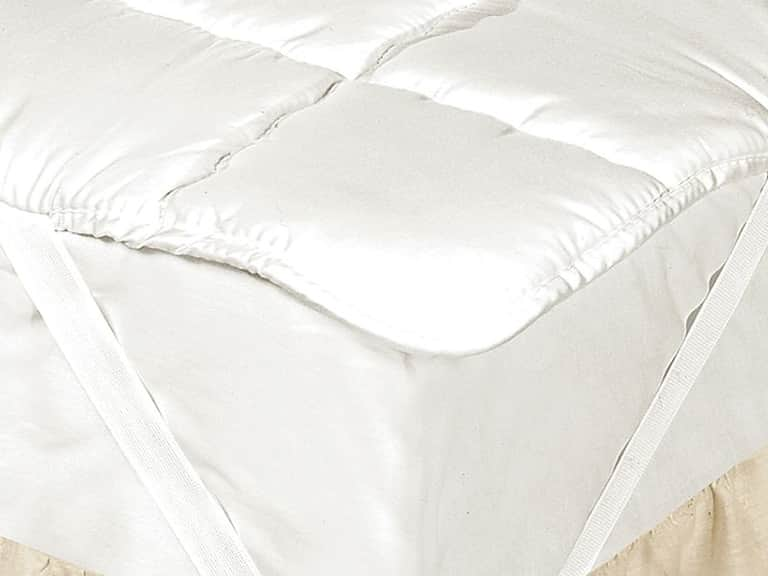
Mattress pads and toppers deserve special attention because they add bulk and can affect the fit of every layer above them. A pad with elastic anchor bands may stay in place, but the mattress height still needs to be included in your sheet measurements. The DownTown Company Luxury Silk Mattress Pad, for example, is described with elastic corner anchor bands and a cotton cover. As with any pad, check its dimensions, care requirements, and suitability for your particular adjustable setup before adding it.
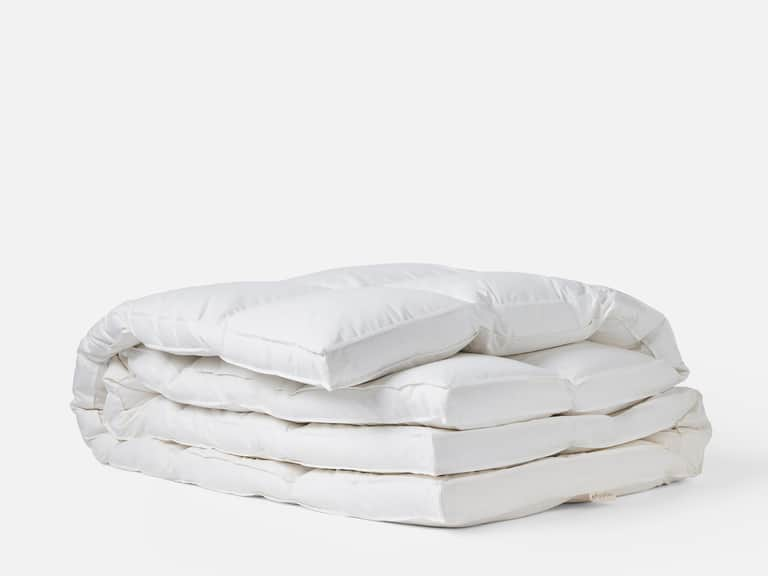
Thick, lofty layers can soften a mattress, but they may also shift or change how the bed flexes. A featherbed, mattress topper, or thick pad should not be treated as automatically compatible simply because it fits the mattress. Read the accessory and base instructions, and test the bed carefully after making changes.
Find pillow support for an elevated head position
When the head of an adjustable bed rises, the angle between the torso and the head changes. A pillow that feels comfortable when lying flat may suddenly feel too tall, too firm, or as if it is pushing the chin toward the chest. Conversely, a low pillow that works on a flat mattress may not provide the support you want when you are sitting up to read.
Instead of choosing pillow loft by label alone, check how your head and neck feel in the positions you use. The goal is a comfortable, supported position rather than a rigid rule about one ideal height. If you sleep on your back, pay attention to whether your head feels tipped forward. Side sleepers may need enough loft to fill the space between the shoulder and head, while still avoiding a tilted neck. Stomach sleepers often prefer a lower profile, though an elevated base may not be their usual position.
Body proportions, shoulder width, mattress softness, and pillow compression all influence the result. A pillow can also behave differently when you sit up: it may slide toward the headboard or compress behind the neck. Keep a small cushion nearby for reading if needed, but avoid stacking several pillows under the head for extended sleep without checking that the arrangement feels comfortable and stable.
Many people find it helpful to test support in stages: lie flat, raise the head slightly, then increase the elevation to the position used most often. Notice whether the pillow stays in place, whether the neck feels comfortably supported, and whether the shoulders remain relaxed. Repeat the check with your usual sleep posture; a reading position and an overnight sleeping position may call for different pillow arrangements.
Consider pillow fill, firmness, and adjustability
Fill affects how a pillow responds to pressure and movement. A resilient latex core tends to spring back after compression, while softer fills may compress more as the head settles in. Wool can provide a cushioned layer and is often valued for moisture management. Down and feather fills have a different, more moldable feel. No material is universally best; the right choice depends on comfort, support, care preferences, and any sensitivities.
Construction matters as much as the fill. Some pillows allow adjustment or have removable layers; others have a fixed profile. A pillow with a fixed loft may be simple to maintain but less adaptable if you alternate between flat and elevated positions. For a pillow that combines a latex core, wool wrapping, and an organic cotton zippered cover, see the Natural Wool-Wrapped Latex Bed Pillow. Its described construction offers a distinct option to consider, but pillow height and firmness should still be evaluated against your body and sleeping position.
Use pillowcases that fit without pulling tightly across the pillow or leaving excess fabric that can bunch beneath your head. Keep a spare pillow within reach if you frequently change between sleeping and reading positions. If a pillow causes persistent discomfort, do not assume that raising or lowering the base will solve it; reconsider the loft and firmness, and seek professional guidance for ongoing pain or other health concerns.
Create a simple setup routine
A quick routine after making the bed can help catch problems before they become nightly annoyances. Begin with the base flat, smooth the fitted sheet across the mattress, and check that all corners are fully seated. Arrange the top sheet or duvet with enough room at the foot to accommodate movement. Place pillows where they will remain reachable when the head section is raised.
- Check the specifications. Confirm mattress dimensions, height, base compatibility, and any split configuration.
- Fit the sheet carefully. Seat each corner fully and check that elastic is not strained or twisted.
- Test the movement. Raise the head and feet through normal positions while watching for slipping, bunching, or tension.
- Adjust the covers. Reposition the duvet or use separate top layers if one shared cover pulls across the bed.
- Test pillow support. Try the pillow flat and elevated, then make small changes to loft or placement.
Repeat the movement check whenever you add a topper, replace the sheets, or change the arrangement. The best bedding setup is the one that performs in real use, not just the one that looks smooth in a flat position.
Care and maintenance that preserve fit
Washing and drying can affect a sheet’s feel and dimensions, so follow the care label rather than assuming all cotton or blended fabrics behave alike. Avoid overloading the washer, which can prevent sheets from rinsing thoroughly, and use a drying method appropriate to the fabric. If a fitted sheet begins to feel tight after laundering, compare its current fit with the mattress depth and review the manufacturer’s care instructions.
Inspect elastic, seams, and corners from time to time. Worn elastic can make even a correctly sized sheet slip. Rotate or replace bedding as needed, and wash mattress pads according to their labels. Some fills and materials require specialized care; a pad that calls for professional cleaning should not be treated as machine washable simply for convenience.
Keep the adjustable base’s moving parts clear of loose fabric, cords, and objects. Do not tuck a sheet or blanket where it could catch in the mechanism, and follow the base manufacturer’s safety instructions. A tidy bed should never come at the expense of safe operation.
Common mistakes to avoid
- Buying by “deep pocket” alone: Measure the complete mattress setup and verify the stated pocket depth.
- Ignoring split dimensions: Confirm whether each side needs its own fitted sheet and identify the exact mattress size.
- Assuming every mattress layer is compatible: Check base instructions before using a topper, pad, or featherbed.
- Using the same pillow arrangement for every angle: Test support in the elevated positions you actually use.
- Overloading the bed with loose layers: Too much fabric can bunch or slide when the base changes shape.
- Skipping a movement test: A bed can look perfectly made while flat and behave differently once raised.
A final checklist for adjustable-bed comfort
Matching bedding and pillows to an adjustable bed is mostly a matter of coordination. The sheet must fit the mattress as it is actually used, including protectors and pads. Elastic and corner construction should keep the fabric anchored during movement. Split beds need bedding sized for their individual sides, and top layers should be arranged so one person’s adjustment does not pull everything out of place. Pillows should support a comfortable head-and-neck position in both flat and elevated settings.
Before settling on a setup, confirm mattress and base compatibility, measure the full sleep surface, and test the bed through its normal range. Then make small, practical adjustments: a better-fitted sheet, fewer loose layers, a different pillow loft, or separate covers for independent sides. The most comfortable arrangement is not necessarily the most elaborate. It is the one that stays secure, feels supportive, and lets the bed move without turning bedtime into a nightly reset.
Quick questions about bedding for adjustable beds
Do adjustable beds need special fitted sheets?
Not always, but sheets with the correct pocket depth and secure elastic are important. Check the mattress and base guidance, then test the fit while the bed moves.
Can one fitted sheet cover a split king?
That depends on the bed’s configuration. Many split kings use two Twin XL mattresses and separate fitted sheets. Confirm the dimensions and setup before buying.
Should I use a different pillow when the head is elevated?
You may prefer a different pillow placement or loft, but there is no single answer for everyone. Test support in your usual positions and choose what feels comfortable without forcing the head forward or leaving the neck unsupported.
How can I stop bedding from sliding?
Start by checking sheet size, pocket depth, and elastic condition. Secure the duvet insert, reduce excess fabric, and consider separate top layers for independently moving sides. Keep all bedding clear of the base mechanism.